
Pages

Sunday, 14 August 2016

Commentary SEA&SEA Unveils New Sony Alpha a6300, Canon EOS 80D Camera Housings

Welcome to the DeeperBlue.com Forums, the largest online community dedicated to Freediving, Scuba Diving and Spearfishing. To gain full access to the DeeperBlue.com Forums you must register for a free account. As a registered member you will be able to:

  • Join over 38,500+ fellow diving enthusiasts from around the world on this forum
  • Participate in and browse from over 473,000+ posts.
  • Communicate privately with other divers from around the world.
  • Post your own photos or view from 5,500+ user submitted images.
  • All this and much more...
  • You can gain access to all this absolutely free when you register for an account, so sign up today!


    Source: Commentary SEA&SEA Unveils New Sony Alpha a6300, Canon EOS 80D Camera Housings

    Saturday, 13 August 2016

    Fuji X-A3 Coming Very Soon

    By admin, on August 13th, 2016

    Fuji X-A3 coming soon image

    Fuji X-A3 is coming very soon and we will sure see official announcement of Fuji entry level mirrorless camera at the end of the month according to FR.com. The Fuji X-A2 was the only camera in mirrorless line-up that features traditional CMOS sensor and not a X-trans sensor. It's really interesting to see what Fuji is actually planning to implement inside the camera a Bayer or a X-trans. We are expecting to see a second generation of X-Trans sensor, (16.3MP APS-C X-Trans CMOS II) inside the camera.

    Fuji already discontinued it's X-M1 series of entry level camera announced back on June 25, 2013 and its update hasn't arrived yet. It's very clear that Fuji wants to keep only one entry-level line alive instead of two.

    STAY WITH ON FACEBOOK | TWITTER | GOOGLE+ to get live news + Fuji rumors 24X7


    Source: Fuji X-A3 Coming Very Soon

    Friday, 12 August 2016

    iPhone vs Digital Camera: Which One Should Bloggers Use?

    iphone vs dslr

    Building your brand as fashion blogger is an exciting time. You're pursuing your dreams, getting your message out, and learning a ton of new things. Everyday is so different. You're creating content, updating social media, and making new to-do lists. With all of the photos you're taking, you're probably curious about cameras.

    Photography is the biggest part of your brand. It showcases everything about you –  who you are, what you do, your style, and your editorial focus. A camera is central to the success of your blog…and you might even be wondering if you should upgrade from your smartphone to a "professional camera".

    There's a great saying that the best camera is the one you have with you. It's so true! When inspiration strikes, the most important thing is to capture the idea as quickly as possible. As an artist and photographer, I use both my iPhone and an Olympus E-M10. Today I'll discuss the advantages of each, and how I use them at work.

    Using Your iPhone…

    Smartphone manufacturers have really stepped up their camera game. I currently shoot with an iPhone 6 and it produces sharp, colorful images. I've taken some of my best photos on my iPhone because of its portability.

    Always having a camera with me has improved the composition and artistry in my work while using this device. In fact, many of the photos in my book, Ineffable | Vol. 1 Photography, were taken with my iPhone. It's portability allowed me to take some great spontaneous shots.  And, the resolution actually worked for my publication.

    Ineffable book cover

    Other phone manufactures have great cameras, too.  Get comfortable using yours. You'll develop a preference for certain types of photos using your phone. I prefer to use my iPhone for the following:

  • Documenting my artistic process
  • Selfies for editorials or branding purposes
  • Supplemental outdoor shooting while hiking
  • For scale selfie

    The focus of my blog has developed over time. While I still write about fashion, many of my posts explore my artistic practice. Using my iPhone to photograph the stages of my paintings has helped me grow tremendously. It allows me to revisit the process and write about it.

    Posting these stories allows people to understand my work and connect with me. This rich dialogue would otherwise be lost without my iPhone. Consider documenting a behind the scenes aspect of growing your brand through photos. It can be a great addition to your posts.

    Artistic Process

    Not ready for a professional camera? That's ok! There are many great add-ons to enhance your iPhone photography. Clip-on lenses, tripods, and selfie sticks are good investments. They allow some variety to the composition and effects of your photos while being budget friendly. I have a set of clip-on lenses by Zeso. For $18, you can experiment with fisheye and macro lenses.

    …Or Using A Digital Camera (such as the Olympus E-M10)

    Portability was the most important factor when I was shopping for a camera. I spoke with professionals and did lots of research. When you're ready to the leap and invest in a professional camera, you'll need to decide between a traditional DSLR or a mirrorless camera. A DSLR has a mirror inside that reflects light through the lens of the camera. A mirrorless camera allows light to pass right through the lens. Both take great photos, but the mirror in an DSLR adds additional weight.

    The Olympus E-M10 is mirrorless. I purchased it because of its lightweight body, and the variety of interchangeable lenses. I never feel weighed down by my gear. I also have greater creative freedom in controlling the composition, lighting, and shooting speed. It definitely surpasses my iPhone for the following:

  • Fashion editorials
  • Street photography
  • Macro shots
  • Landscapes
  • My finished paintings
  • More artistic self portraits
  • I currently have a 14-42 mm lens, which has a great wide angle for shots. There are many more advanced lenses available, but this suits most of my needs.

    Photo credit Susan Walker

    Pros & Cons of Each

    Both cameras are great for different uses. To recap, here are some of the pros and cons of each device:

    iPhone

    Pros:

  • Lightweight
  • Easily accessible
  • Autofocus allows user to point-and-shoot for wonderful photos
  • Resolution is generally good enough for most blogging and social media purposes
  • On-phone apps allow for easy editing and uploading of photos
  • Cons:

  • Limited ability to control focus
  • Poor zooming capabilities
  • No control quality or amount of light in the frame
  • Not fast enough for action, editorial, or street photography
  • Digital Camera

    Pros:

  • Great zooming capabilities with professional lenses
  • Ability to control lighting and contrast
  • Sharper images
  • Produces larger image files for quality printing
  • Faster shooting speeds
  • Cons:

  • Expensive
  • Learning curve for using all of the settings
  • File size are much larger and require more storage space
  • Which do you prefer? Do you shoot with one or the other, or do you shoot with both? Comment below with any other tips you have!
    Source: iPhone vs Digital Camera: Which One Should Bloggers Use?

    FREE: Fuji X-A1 Mirrorless Camera

    I am giving away my Fujifilm camera and selling some Fuji glass. The X-A1 is free with purchase of at least one of XF 27mm F2.8 ($360), XF 18-55 F2.8-4 ($500) or XF 55-200mm F3.5-4.8 ($600) Fujinon lenses. Items can be combined and price is negotiable.

    Last hour Last 24 hours All Views Browsed
    Source: FREE: Fuji X-A1 Mirrorless Camera

    Thursday, 11 August 2016

    Travel Cameras

    Travellers Choice Trip Advisor

    Canon is the winner of the TripAdvisor Travellers' Choice Awards 2016 for it's range of Compact, Mirrorless and DSLR Digital Cameras.

    This page helps you choose a camera best suited to meet your specific Travel needs. We provide insights to the different types (Compact, Mirrorless and DSLR) so you decide what is right for you. We also give suggestions for specific types of travel, from family holiday to wildlife adventure!

    Making sure you capture your unique memories is so important and we can help you, as Trip Advisor members can attest, voting us Best Compact and DSLR Camera brand.

    Best Travel Compact Cameras

    ]]>
    Source: Travel Cameras

    Sea & Sea Announces Housing for Sony a6300

    Sea & Sea has just released a formal announcement regarding their housing for the Sony a6300.

    The Sea & Sea MDX-A6300 is the latest housing for one of the year's most desired mirrorless cameras. Among the new features, a few stand out. First, the housing features two bulkhead ports that can be used either as standard sync cables or to connect a video monitor or a vacuum leak system.

    Another DSLR-like feature on the housing is the inclusion of an external port lock and release. With this, you can swap lenses and ports in between dives without the hassle of removing the housing's back. Finally, the housing provides access to the camera's tilting LCD screen for easier viewing from low angles.

    The housing is currently available with a price tag of $1799.95. For more information, consult the press release below.

    When purchasing underwater photography equipment like the products mentioned in this article, please support DPG by supporting our retail partner—Backscatter.com.

    Press releaseMDX-a6300 HOUSING for Sony Alpha a6300 Mirrorless Digital Camera

    NEW FEATURES

  •     Two (2) Accessory Ports. Accessory ports may be used for vacuum leak system, sync cable, or a video monitor.
  •     External Port Lock and Lens Release. Conveniently switch lenses between dives without removing the housing back. Activate the Port Lock on the front of housing and push the Lens Release for quick and easy lens swap.
  •     LCD Tilt and Monitor Hood. The Camera's LCD display monitor can be tilted 10O for easier viewing allowance. Monitor hood may be used (optional)
  •     Luminescent Buttons. Easily view controls in low light conditions.
  •     Accessory Compatibility. Easily attach Sea Arm 8 Camera Tray and Grip for a compact system. Compatible with NX* and ML ports.
  • FEATURES

  •     Equipped with two (2) Fiber-Optic Cable Sockets
  •     Equipped with two (2) accessory ports
  •     Equipped with two (2) Sacrificial Zinc Diodes (front/rear)
  •     Built-In Leak Detector Sensor (optional)
  •     Body: Corrosion-Resistant Aluminum Alloy (machined)
  •     Depth Rating: 75m / 330ft
  •     Dim. (WxHxD): 195 x 125 x 100mm 7.7 x 4.9 x 3.9inch
  •     Weight: Approx. 1,265g / 44.6oz (housing only, w/ grip)
  •     Compatible with SEA&SEA Strobes, Sea Arm 8, Fiber-Optic Cable II, ML Handstrap, Vacuum Pump System (TBA)
  • ITEM NO: SS-06182DESCRIPTION: MDX-a6300 Housing for Sony Alpha a6300 Mirrorless Digital CameraPRICE: $1799.95


    Source: Sea & Sea Announces Housing for Sony a6300

    Wednesday, 10 August 2016

    Olympus, Nikon reveal big sales drops: Why the Kumamoto quake devastated the camera industry

    Over the last few days, Japanese companies have been releasing their financial reports for the first quarter of their 2016 fiscal year. (That is, for the period from April to June 2016; the Japanese fiscal year doesn't follow the calendar year, but instead runs from April 1st to March 31st.) Among those doing so are both Olympus and Nikon, and neither report paints a pretty picture of the digital imaging market in the wake of the 2016 Kumamoto earthquake, which struck early in the fiscal year on April 16th, and whose damage was compounded by hundreds of aftershocks in the following days.

    In its report, Olympus noted a whopping 25.5% decrease in its Imaging Business' net sales for the quarter, year-on-year. Mirrorless camera sales fell by some 23% to 10.8 billion yen in the same period, while compact camera sales -- a very small slice of the pie these days -- dropped by 25% to just 3.8 billion yen. Nor was the news from Nikon any better. Net sales for the company's Imaging Products Business in the quarter were down by 31%, and interchangeable-lens camera unit sales dropped by 32%. Nikon's compact camera sales in the quarter plunged even more precipitously, dropping some 45%.

    But can much of this really be attributed to a natural disaster? Most people don't realize how devastating an impact the Kumamoto earthquakes have had on the camera industry. IR and other news outlets have told the story [Earlier articles here: 1, 2, 3, 4, 5] of how the quakes shut down the major Sony camera-sensor plant there, and how that would impact most camera makers given Sony's dominant position in the sensor business.

    Along with everyone else, we here at IR breathed a sigh of relief when Sony announced that the plant was operational again, as of May 13th 2016.

    Phew! They got it back up and running, and chips are flowing off the production line again, right?

    Well, not exactly. In fact, not at all.

    This was a major quake by any standard, measuring 7.0 on the Richter scale, but that's only part of the story. It was also a very shallow quake (6.8 miles or 11km below the surface), so ground shaking was much more severe than it would have been in a similar-magnitude event happening many miles underground. It was an 8.8 on the Mercalli scale, based on the effects of quakes vs their moment magnitude. That level would normally correspond to a Richter-scale quake of 8.0 or higher.

    And the Sony Kumamoto Technology Center was only about five miles from the epicenter.
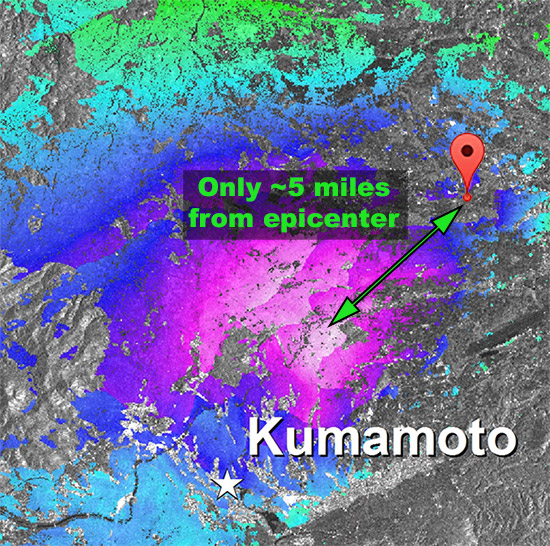
    So this was a very severe quake, and the Sony sensor plant was sitting nearly on top of it, just a few miles away. The entire area was devastated, with landslides cutting both road and rail routes into the area. (We were told by an industry source outside Sony that it took them a week just to get into the plant.)

    Sensor manufacturing involves literally hundreds of steps, with many of them requiring critical process control, extraordinarily precise alignment, and the complete absence of dust particles. If anything goes wrong in any of these areas, an entire batch of chips can be lost.

    Now imagine a major-magnitude earthquake, power failure, the likely breaching of cleanroom areas, and ultra-precise wafer-patterning equipment being shaken a few feet in each direction. (That's probably an understatement; the ground along the fault line ended up being shifted by 1.8 meters laterally, and raised up 70 centimeters. Furthermore, it appears that the 1.8 meter movement happened in just 20 seconds.)

    It only takes a moment's thought to realize that this wasn't a matter of a factory having to shut down until they could get the lights back on and mop the floors. To the contrary, all work in process was lost. This means that, once they got the plant running again, the entire manufacturing process had to start from scratch, starting from raw wafers.

    The complexity of the semiconductor fabrication process means it takes a long time from raw wafer to finished sensor. A loooong time. About three months. So after the production resumed on May 21st, it would require three months, give or take, for the first sensors to start coming out the other end. In other words, the first chips since the quake will only be starting to ship sometime about now. 

    The industry didn't lose just 36 days or so, it lost more than four months of production. A third or so of an entire year's output. But wait, there's (probably) more...

    Sony has made no comment on the internal state of the plant, but it's hard to imagine that a lot of delicate equipment wasn't badly damaged, at least some of it to the point of needing to be replaced or significantly overhauled. But these aren't machines you can just run down to the corner superstore to pick up another one. Many will be build-to-order items, with long lead times.

    So as an industry, we're not out of the woods yet. Even if sensors are about to start coming off the line again, they probably won't be doing so as quickly as before the quake.

    The good news, though, is that thanks to herculean efforts on the part of Sony's manufacturing engineers and plant employees, chips are about to start flowing out to the market again, and we are going to see new products being announced again in the runup to this year's Photokina show in late September. All indications are that this fall is going to be an exciting time in the camera business!


    Source: Olympus, Nikon reveal big sales drops: Why the Kumamoto quake devastated the camera industry